
Hi Anne,
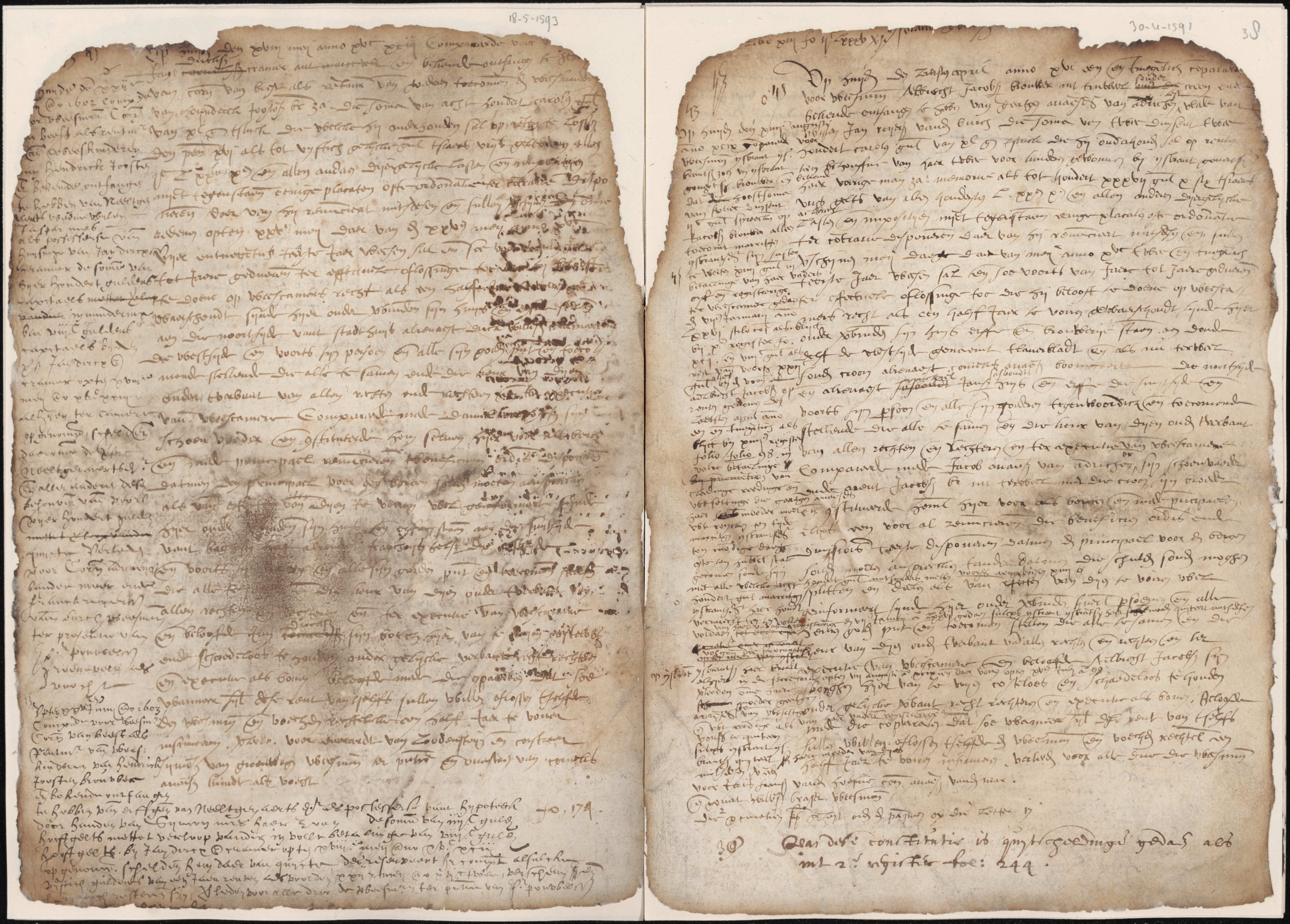
Their names are to be found in the marginal notes on the left page. These notes are however post-1599. To fully understand these, one needs to know that the Orphans' Chambers not only were in charge of making sure orphans (one was already alled an 'orphan' if one of both parents had died and the other parent was still alive) received their childs' part of the inheritance of the deceased parents and to act as legal guardians of the orphans, but also acted as financial institutions to acquire the means to fulfill the aforementioned tasks. Financial reserves to that purpose originated from money deposits made by the surviving parent in favour of their children (who would receive their rightful part when they came of age or at the moment they married); to increase these reserves, the money was invested in relatively low-risk investments such as mortgages and bonds.
From the main text as well as from marginal notes we learn that on 18 May 1593 a peddler (kamer) named Jan Dircxss took a mortgage of 800 guilders, which was provided from the money reserved for the children of the late Hendrick Joosten, a brewer, deposited with the Orphans' Chamber. Apparently, at a certain moment between 1593 and 1602 Neeltgen Aerts became the owner of this mortgage (as mortgages were transferable from one person to another). The first marginal note states that in 1602, on 22 May (that part of the paper has been damaged, the month however could be derived from the main text) Neeltgen Aerts, mentioned as widow of the late Jasper Mes, paid 400 guilders, the first half of the mortgage amount, to the Orphans' Chamber; Cornelis van Beest, steward (rentmeester) of the Orphans' Chamber acted on behalf of the orphan children of Hendrick Joosten.
In the second marginal note it is stated that on 22 June 1603 Simon Mes paid the second half of the mortgage amount, acting as son of Neeltgen Aerts on behalf of Neeltgen Aerts' heirs; this implies that Neeltgen had died in 1602 or 1603. Cornelis van Beest acted again as steward and as such acquitted Simon from payment of the interest (50 guilders )over the period 22 June 1602-22 June 1603.
The density of the text therefore was not to save space, but to keep the marginal notes close to the text it was connected with; the main text concerns the original mortgage agreement of 18 May 1593 between peddler Jan Dircxss and the Orphans' Chamber, also then represented by steward Cornelis van Beest. The house that was collateral in this mortgage was situated north of the City Hall and next to the house of Dirck Willemsz, probably clockmaker (the word is hard to read)
Anne
zei op vrijdag 24 januari 2025 - 10:37