Page 2


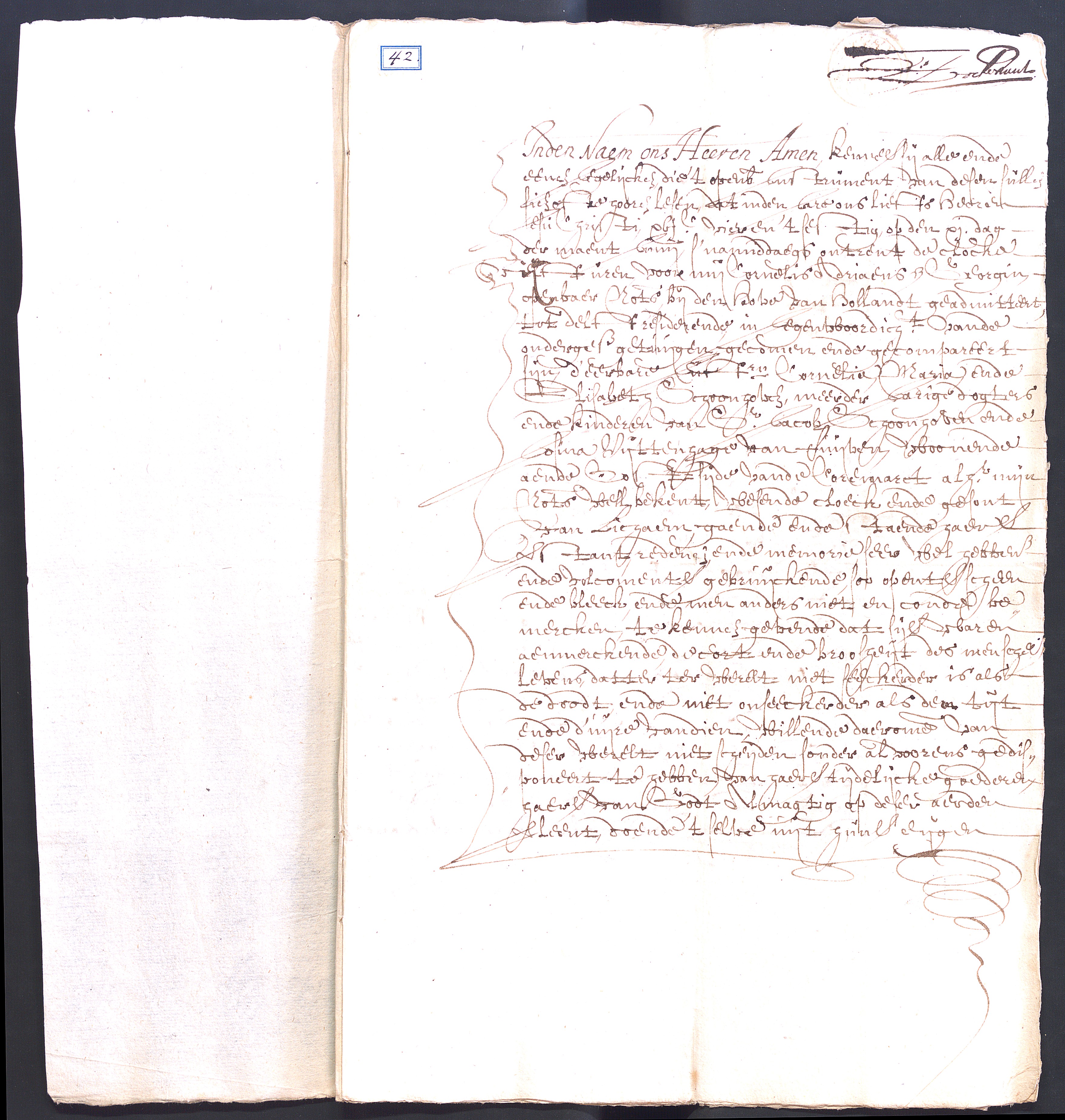
This is described as a 'reciprocal will' of Cornelia, Maria, & Elisabeth Schoonhoven - 3 sisters who ran De Clauw pottery factory in Delft for nearly 40 yrs.
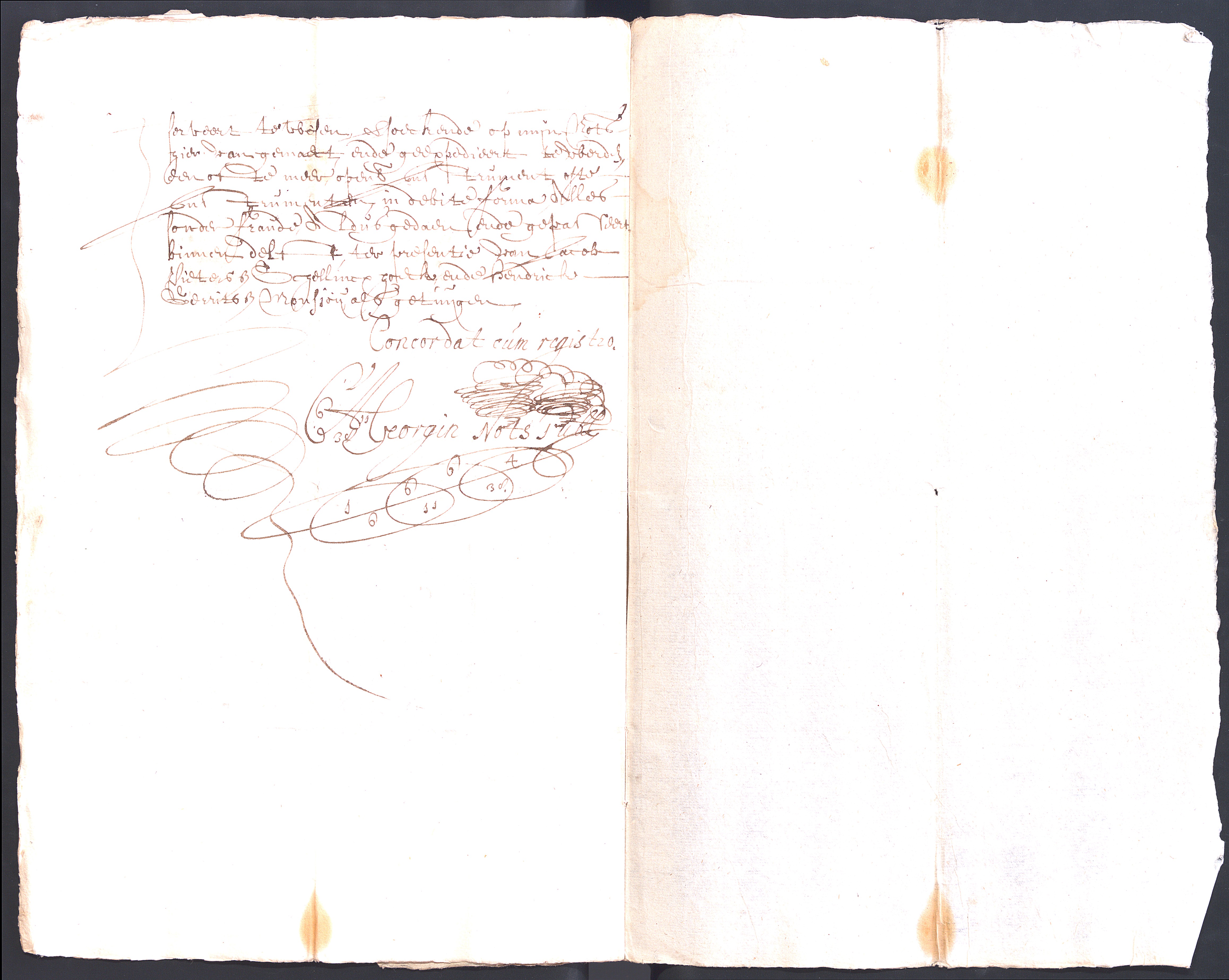
I'm not sure this is the actual will as there are no signatures on it? Could this just be a copy of the original?
I'd be grateful if someone could explain what the sisters have agreed about their estate between them.
Hartelijk dank!
Anne
Page 2
page 3
Dear Anne,
It is indeed a copy, which can be concluded from two aspects:
- the notary signs with Concordat cum registro = matches with the [deed in the] register
- the text is preceded by a vertical line to the left of the text to indicate this is copied from a previous document
The sisters appearing are Cornelia, Maria and Elisabet Schoonhoven, all daughters of Jacob Schoonhoven and Gosina Uyttenhage van Ruyven. The three daughters were living on the east side of the Korenmarkt. The will states that the first one to die bequeaths her inheritance to her surviving sisters. The will also states that, at the moment one of the surviving sisters would marry, the marrying sister should deny her rights to the inheritance and hand them over to the surviving sister still unmarried.
Apparently, this will was meant to keep the wealth 'within the family' and to keep the inheritance out of the hands of the (family of) marriage partners. The will does not specify the contents or any goods of the inheritance.
Hi Rene
Many thanks as always for your reply.
I did wonder about the wavy lines :-) so that makes sense now.
As it turns out none of the sisters married. Elisabeth the youngest died in 1712 but she did write a will in 1710 which I think could be quite interesting. I'll post it on the forum so if you or any of the other contributors could look at it that would be great.
Do you know if inventories for estates are kept separately in Delft archives? I can't seem to find them anywhere, which is frustrating, as I'm sure they would provide so much information about the women pottery owners- like the one I found for Barbara Rotteveel which you helped to transcribe and translate recently. Oddly Barbara's documents were on the regular Delft people search at the online archives.
very best wishes
Anne
Dear Anne, I cannot find a boedelkamer or desolate boedelkamer for Delft. Remembering Vermeer I looked at the Vermeer page of the Stadarchief Delft at https://www.stadsarchiefdelft.nl/uitgelicht/johannes-vermeer/ showing an image from the 1675 inventory found in a notarial register. You should really use for 18th century inventories in Delft the work by Thea Wijsenbeek-Olthuis, Achter de gevels van Delft. Bezit en bestaan van rijk en arm in een periode van achteruitgang (1700-1800) (Hilversum 1987). She also wrote the general guide 'Boedelinventarissen,' in: B.M.A. de Vries e.a. (red.) Broncommentaren 2 (Den Haag 1995), pp. 1-73I, online at https://resources.huygens.knaw.nl/pdf/Broncommentaren/voorlopig/Broncom… ; she mentions the Delft weeskamer, too, in this guide. She contributed also the chapter ‘Delft in the eighteenth century’, in: A.M. van der Woude and A.J. Schuurman (eds.), Probate Inventories (Wageningen 1980) 157-177.
I could readily find these tiiles in the literature overview of the socalled online Boedelbank of the Meertens Instituut, Amsterdam, https://boedelbank.meertens.knaw.nl//index.php?actie=literatuur#nl . By the way, The Montias Database, http://research.frick.org/montias/home.php, enables you to search directly for inventories created by desolate boedelkamers or weeskamers, however only for inventories with art object written the seventeenth century
Dear Otto
Many thanks for your reply and all your suggestions.
The Vermeer website is fantastic. I do have a copy of the inventory of 1675 for Vermeer's wife, Catharine Bolnes and her mother Maria Thins. It's very interesting for many reasons. Compared to Barbara Rotteveel's inventory there is no mention of Delftware or Porcelain at Vermeer's home. Now obviously Barbara had a lot as that was her business, but still it was surprising to see none at Catharine's home. I thought it was fascinating to see how many attributed paintings were in the house too. Also I know it's a much discussed point, but there was no gold or silver mentioned, or luxury good or textiles. I read it's possible the women had already disposed of these items before the inventory was taken. Catharine after all had 10 children to support.
I will follow up the other links you've given. Thea Wijsenbeek-Olthiius sounds like she is very knowledgeable and could lead me in the right direction.
I've never heard of the Meertens Instituut, but will definitely look into them too.
This is the problem when you're trying to do research in another country :-( But then that's the wonder of this great website to have helpful people such as yourself, willing to share their vast knowledge to help others with their research :-)
I really do appreciate your help.
warmest best wishes
Anne
Anne, yesterday I realized I jad assumed for many months that you already knew much more about probate inventories and Dutch history, and you certainly know a lot about Vermeer and potteries! I could have share this information much earlier on... Wijsenbeek is the Dutch specialist for probate inventories and Delft. The Boedelbank of the Meertens Instituut gives online access to inventories from four Dutch regions. For completeness' sake I add the link to an online bibliography of medieval and Early Modern probate inventories at http://campus.belmont.edu/honors/WILLBIBHOME.htm .
Many thanks Otto. I've added your latest link with the others you sent yesterday. All useful resources for my project.
Yes unfortunately I'm not as familiar with Dutch history and archives as I'd like, but I'm discovering more and more as I go along. Only last week I realised I could write to Delft archives to ask to see documents that are not online but are recorded for a specific place/family archive. They've been very helpful (and encouraging about my research, which is really kind) so that's a new avenue to explore.
I have found some tentative links with some of the pottery women and their families and Vermeer but that needs more exploration. The remit of my research seems to grow, but that makes it super interesting for me even if it increases my work schedule!
warmest best wishes
Anne
Anne
zei op zaterdag 31 mei 2025 - 16:30