Dear Anne, this deed contains the city´s consent to Jan Claes van der Straten - by the way, it reads literally here Staaten - for using a tower on the city wall as a windmill for sawing paint, "te malen de verew voor de platielbackers." He has to allow Tijntje, the present tenant, her room during her life or to provide aew lodgings for her. Jan has to pay the city a sum of 20 guilders after her death, and of course he has to do the necessary repairs to the tower.

1656- Purchase of a paint mill

This deed concerns Jan Claesz van der Straten, who purchased a paint mill in Delft on Nieuw Langedijk.
Is there any further information such as the price he paid for this?
Many thanks for any help.
best wishes
Anne
Reacties (11)
Two corrections: this act is not a deed but a city resolution, and malen means to grind, not to saw. I live not far from a historic saw mill... Jan has to convert the tower into a mill, a walmolen.
Jan Claesz van der Straten is geconsenteertt
op den eersten Juny 1656 dat hij op den
toorn 't eynde den Langendijck op des stadts
vesten sal mogen stellen een wintmolen
omme te malen de verwe voor de platiel-
backers, mits dat hij geduyrende het leven
van Lijntge, die daer ingewoont heeft,
gehouden sal sijn haer te versorgen van een
ander woonplaets ende naer derselver
overlijden aen de stadt jaerlijcks te betalen
twintich gulden, ende dat hij den toorn mitsgaders het rondeel in be-
hoorlijcke reparatie sal moeten onderhouden,
gelijck deselve hem sal opgelevert werden.
Actum ut supra.
By the way, the deed says Straten and not 'Staaten as Otto says.
@Geert, thankmyou, yes, it is indeed van der Straten, I did not see it right at first, and the lady's name is Lijntge, it looks like a L and that's it!
Dear Otto and Geert
Thank you both for the translation and transcription, which is very interesting.
When Jan Claesz was given permission to convert the tower into a paint mill he was only 20 years old and not yet married (he would do so 2 months later) so in effect he was still a dependent child if my understanding of the laws in Holland at that time?
Would the city of Delft give permission to a 'non-adult' to do this I wonder, or would they not be concerned about his age?
warmest best wishes
Anne
Dear Otto & Geert
Thought you might like to see the painting from 1775 or the paint mill Jan Claesz created- I think!
Anne
p.s. This if from 'De Lamptekan' pottery book by Hoekstra- Klein
Did the attachment come through? I can't see it.
Perhaps its not allowed?
Anne
Only images are allowed with the extensions .png .gif. jpg and .jpeg can be uploaded here. Using RKD Research, https://research.rkd.nl I found a drawing from around 1770, https://rkd.nl/images/238497 .
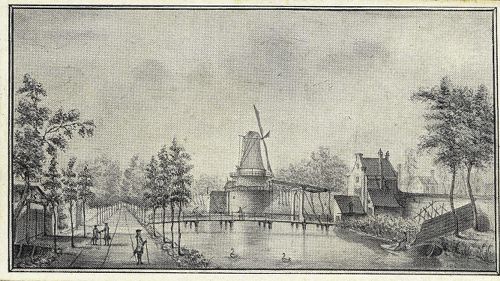
Brilliant Otto!
That's the image I was trying to upload but this is a much better copy.
Many thanks :-)
Anne
Anne,
To your questions regarding his young age. Indeed, at the time, Jan would have been considered a minor (under 25 years of age) and unable to act independently in any kind of legal matter. He would have to be assisted by a guardian. Assuming that you have certainty about his age, there is an exception scenario: a venia aetatis (litterally: privilege of age). A minor, usually with the support of a guardian or parent, could submit a request to the Hof van Holland (the High Court of Holland) for a venia aetatis, which would grant them "adult rights", if approved. Such requests for the years 1613-1700 and the online index to these records can be found here: https://www.nationaalarchief.nl/onderzoeken/zoekhulpen/staten-van-holla…. It's easiest to just put any name in the search bar, hit enter, and then on the next page you can download a zip file containing a csv file with all the names in the index; much easier to just search and filter (not just by name, but also based on place of residence) through this in Excel. I did look for Jan in the index but did not find him there.
There is another element to consider here and that is the nature of the record. If this were a record that documented Jan's appearance before, say, a court or a notary, I would absolutely expect this record to mention the guardian that accompanied him or to state that he had a venia aetatis. But this is not that type of record; it is simply documenting a resolution, i.e. a decision made by the city council. I don't think there was a necessity to include such information and therefore it also does not mean that Jan was not accompanied/supported by a guardian when he made his request for the windmill. Maybe he appeared before the council along with his guardian; if so, this may be captured in council minutes. If it was not done in person but rather in writing, then it may have been a letter sent by his guardian making the request on his behalf, or maybe a letter by Jan accompanied by some kind of written authorization from his guardians; such items could be kept among the incoming requests the city received.
Regards,
Marcel
Hi Marcel
Many thanks for your explanations about Jan and status as an underage participant.
I'm pretty sure of his age as there's a baptismal record for him in Delft archives. Also when his father died in 1653 he was recorded as a 'dependent child' (as was his younger sister) which was right as he was 19 years old.
I didn't realise until Geert pointed out that what I thought was a 'deed' was in fact a resolution from the city council, not a legal document as such. And as you say he could have had a legal guardian with him-either his mother Ariaantge Jansdr van Sanden or his step-father Jan Harmensz van Dijssel. But thanks ever so much for having a search in the national archives for me. I didn't know that was possible so that's a new potential search site for me in the future.
However what's really curious is the Jan appears as the buyer of a house in Delft, together with his uncle Abraham Jansz van Sanden later that year, just before he married, and the house was for Jan Harmensz van Dijssel, his stepfather. Again I don't understand why Jan was involved and why Jan Harmensz couldn't buy the property himself?
very best wishes
Anne
Anne
zei op vrijdag 15 mei 2026 - 13:30