
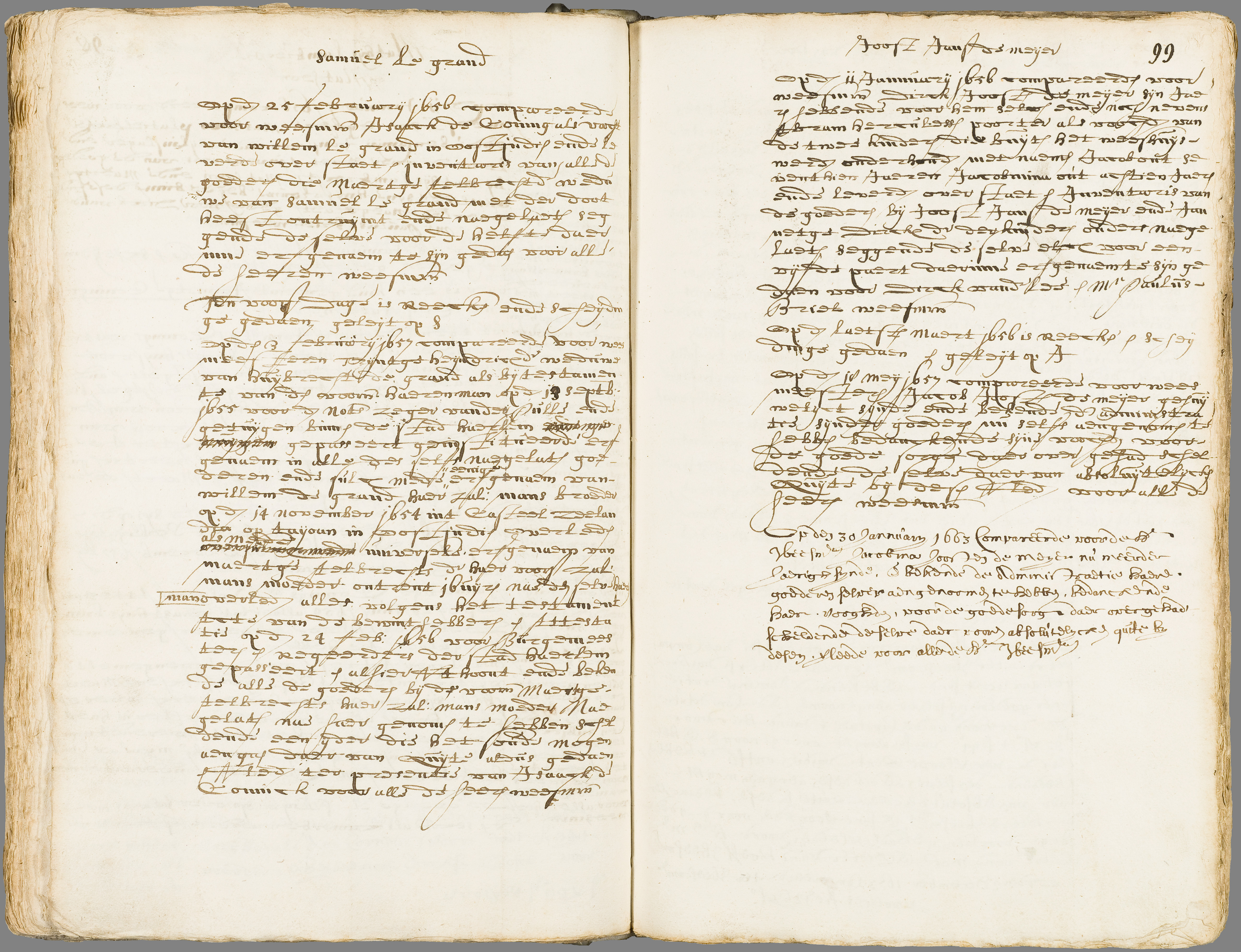
Dear Anne, it concerns a registration in two parts.
The first one, dated 25 February 1656, states that Isaack de Coning appeared before the managers of the local Weeskamer (weesmeesters), as guardian over Willem le Grand, who was in the East Indies. Isaack handed over a statement on and inventory of all goods in the inheritance of the late Maertge Aelbrechts, the widow of Samuel le Grand. Willem le Grand was entitled to half of the inheritance.
The second part, starting from line 13 in the document, is dated 3 February 1657 and states that Trijntgen Heindricx appeared before the weesmeesters. Trijntgen was the widow of Huybrecht de Grand and appointed by her late husband as his heir in his will, composed before the notary Van der Pulle and witnesses in the city of Haarlem on 13 September 1655. As a result of this will, she also became the sole heir of her brother-in-law Willem de Grand, the brother of her late husband. Willem le Grand had died on 14 November 1654 in the fortress called Casteel Zeelant on Tayouan (now know as Taiwan). As Willem was heir to his late mother's inheritance, his widow became also heir to the inheritance of her mother-in-law.
For as far as I understand, in the first registration, it may not have been known at that time that Willem already had died over a year before that; that seems strange, but given the distance between the location of his death (Taiwan) and the Low Countries, it is very probable that the message of his death had not reached the family yet.
From the second registration I understand that Trijntgen Heindricx in the end got all the goods from her mother-in-law Maertge Aelbrechtsdochter: one half she inherited as being the widow of her late husband Huybrecht de/le Grand, who was one of two children of Maertge Aelbrechtsdochter, the other half she inherited as being the sole heir to her brother-in-law Willem de/le Grand, who was the other child of Maertge Aelbrechtsdochter.
Anne
zei op vrijdag, 13 november 2026 - 23:33