p.2
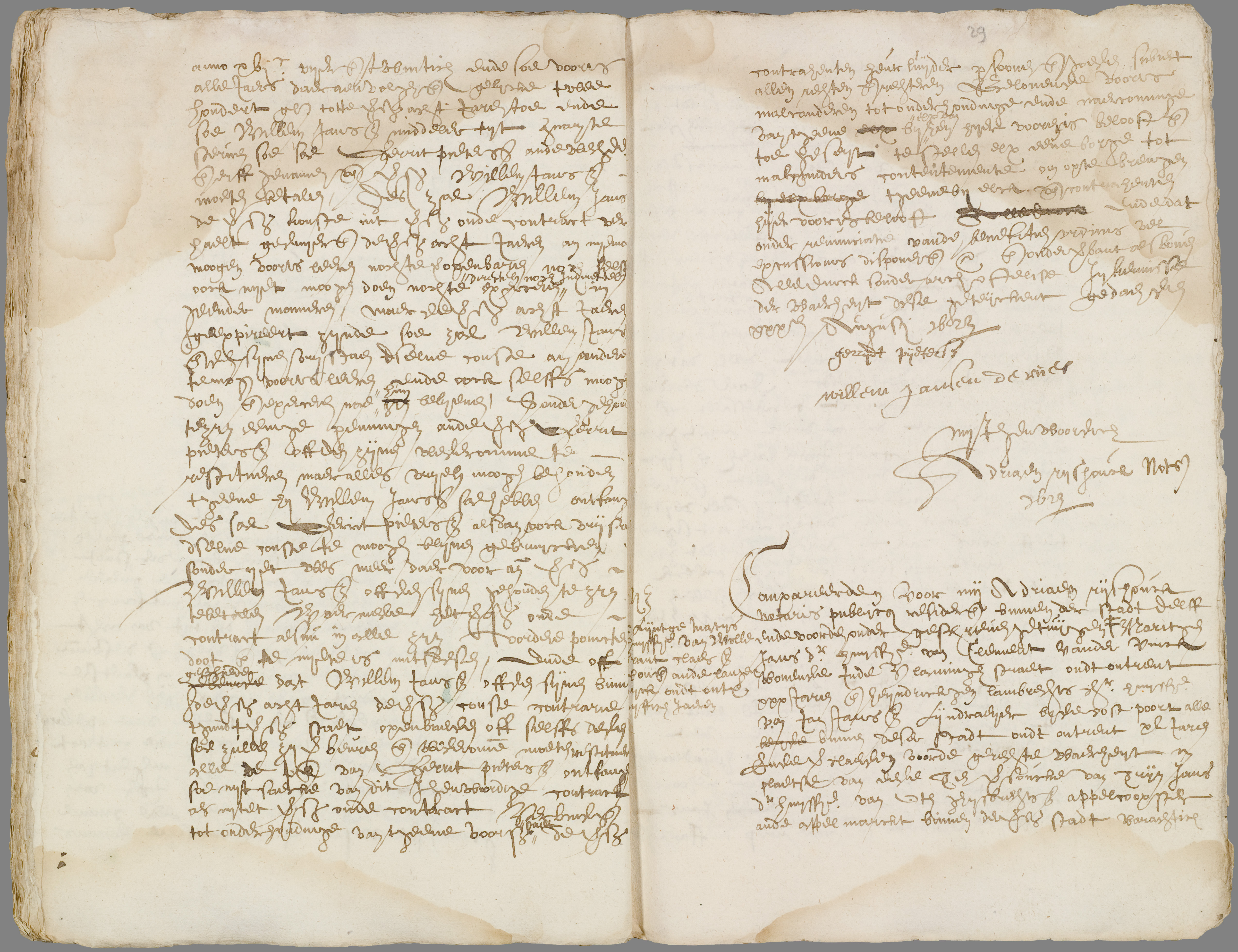

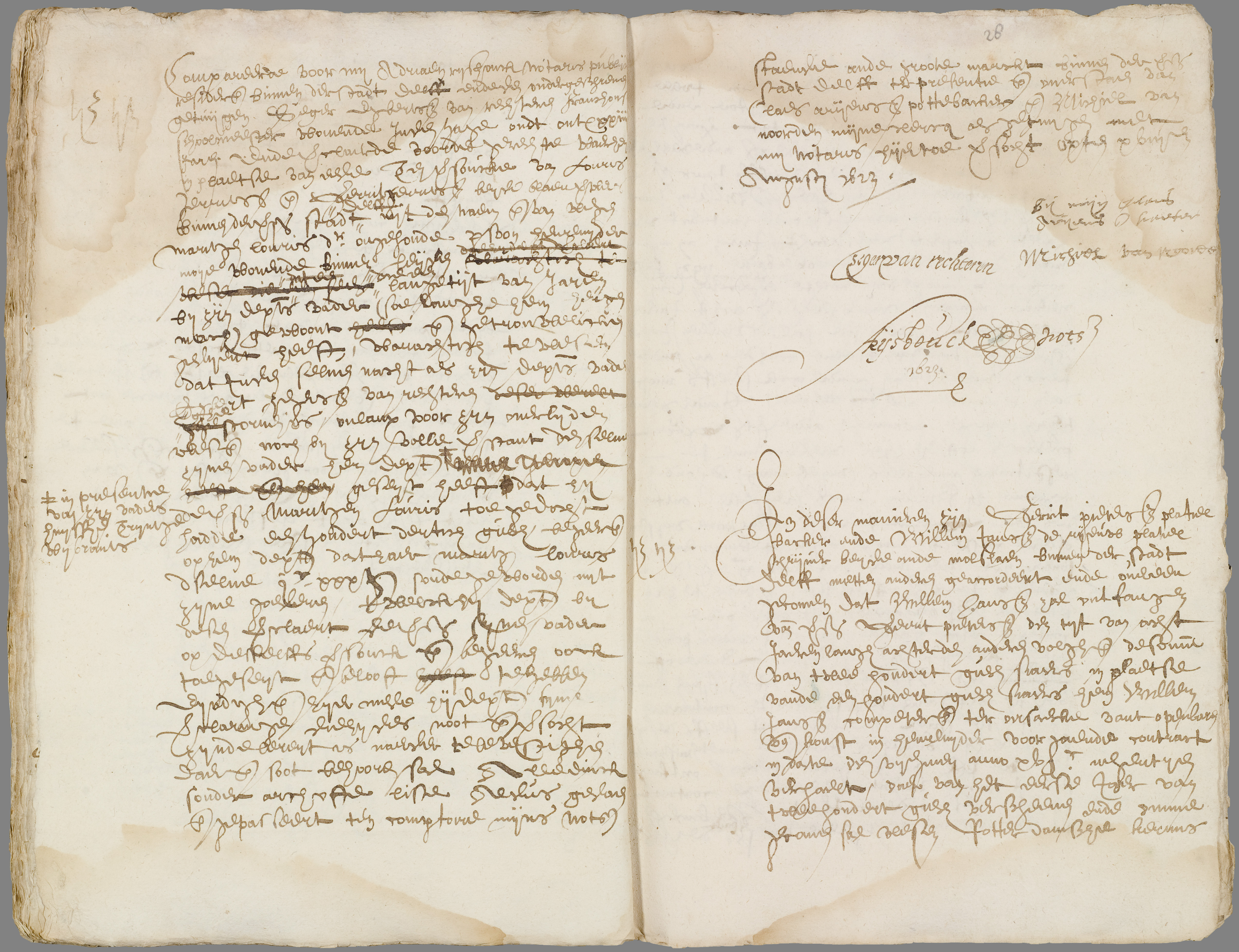
This concerns Gerrit Pietersz and Willem Jansz du Rieu, both of whom featured in my post of 30 April.
Gerrit Pietersz married in 1618, jm, potter, Molslaan, his bride was Lisabeth Cornelisdr, jd, Molslaan.
Gerrit died on 19 September 1624, so just one month before the problem with the paint/pottery house which the earlier post related to, which Lisabeth Cornelisdr called witnesses for.
It would be very interesting to know what this deed was about, as it might shed light on what happened a month later.
Many thanks as always for any help.
Anne
p.2
Hi Anne,
It is an agreement between Gerrit Pietersz(en), pottery baker, and Willem Jansz(en) de Rijeuw, pottery decorator, both residing in the Molslaan in Delft. The content seems to imply that Gerrit buys out Willem; there is no specific reason mentioned for this in this deed, but it may be an act of buying out competition. Gerrit promises to pay to Willem an annual amount of 200 guilders each year for 8 consecutive years. This amount replaces the annual sum of 100 guilders agreed upon between these two men in a previous agreement, dated 7 May 1690. The first payment of the current agreement should be due in 1695 at the date of the annual fair in Rotterdam ('Rotterdamsche kermis'; this was usually celebrated on the first Sunday after Saint-Lambert's Day, Saint-Lambert being the patron saint of the town of Rotterdam, whose memorial day was each year on the 10th of August). The agreement also states that, in case Willem would die before he had fully completed all 8 annual payments, Gerrit would be obliged to complete these payments to Willem's heirs. In return, Willem promises to refrain from practicing his craftmanship during these 8 years. In case he would not keep this promise, Willem would be held io pay back any payments received from Gerrit.
A few corrections on the dates: the previous contract was dated 7 May 1619 (the new contract is from 30 Aug 1623); the first payment of the new contract was due in 1624.
It does not look like a buyout to me. It appears Willem works for Gerrit (which is why Gerrit pays him) and during the 8-year contract, Willem is not allowed to teach his art/craft to others or perform the same work for others. If he violates this arrangement, he has to repay Gerrit. After the 8-year contract is over, the restrictions for Willem no longer apply. At the same time, Gerrit will be allowed to continue using these consten (arts). This is not a regular labor contract as this is not just about the labor Willem provides; it is more like a non-disclosure and non-competition agreement. The key thing is the expertise (maybe a specific process or technique) that Willem brings to the business since it is something that Gerrit can continue to use after the end of the contract. If the contract was just about labor, this would not make sense. The contract does not explicitly say what special art was involved, but since Gerrit was the pottery baker and Willem the pottery decorator, it presumably involved some decoration technique. The original 1619 contract may provide more specifics.
Anne
zei op donderdag 7 mei 2026 - 22:22