page 2
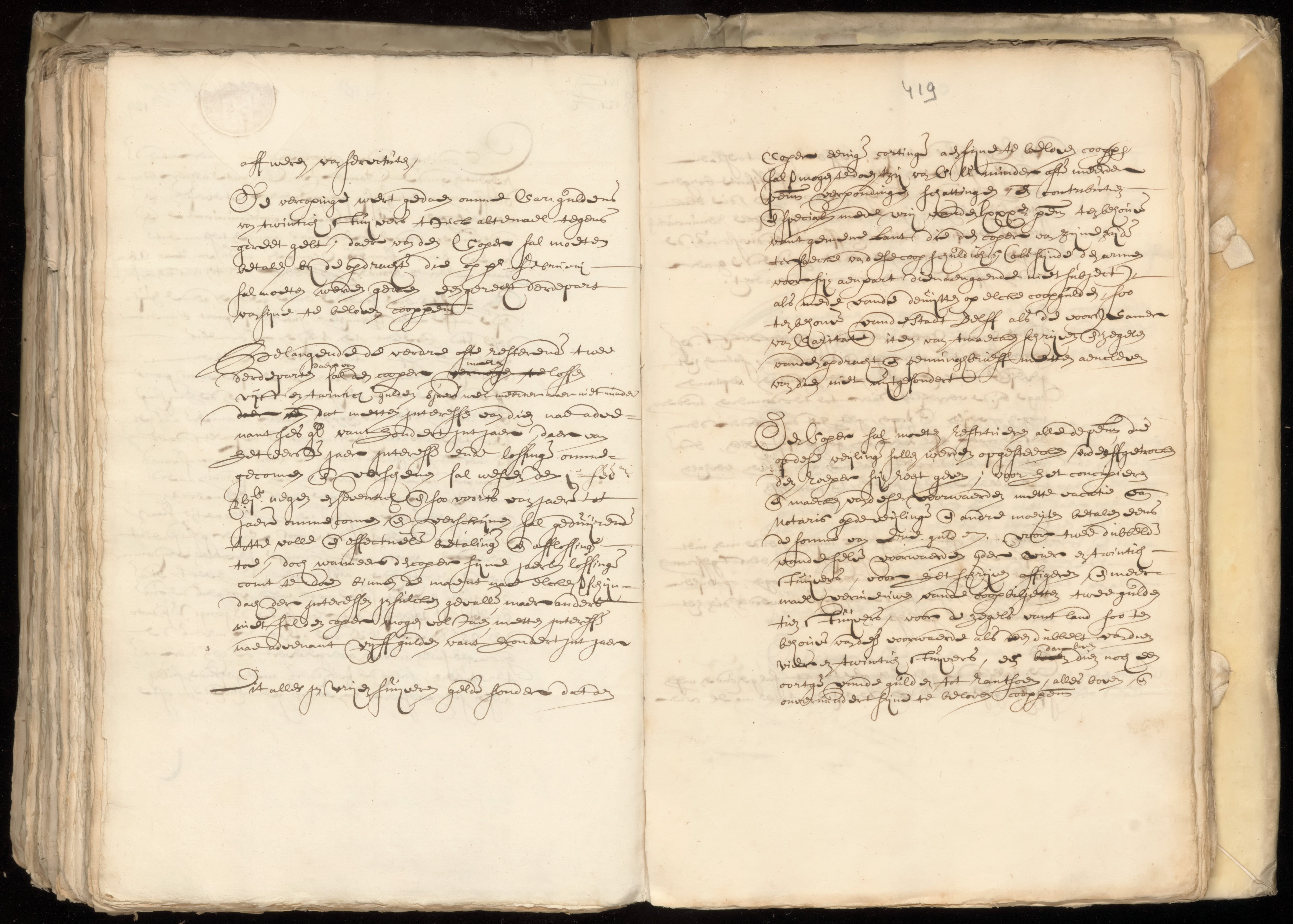


This deed concerns Jannetge Claus (van Straten) now the wife of Willem van Teylingen.
All I know is this is possibly something to do with her buying a property?
It seems a lengthy document- 4 pages, the 2nd (which I will also upload) and 3rd page seem to be individual paragraphs, the final page has some figures.
If it's possible to work out from the first 2 pages uploaded what this is about that would be useful.
With many thanks as always.
Anne
page 2
Hi Anne,
This is a publication of the conditions of a public auction scheduled by the Kamer van Charitate (Chamber of Charity). It concerns an auction requested and approved by the executioners of the last will of the late Sara Fransdochter Compey, the widow of Abraham Gerritsz vander Weerd.
The auction will concern a small house situated on the south side of the Gasthuislaan within the Bijlepoort (between the house of Cornelis vander Houff to the south and the house of Willem van Teijlingen to the north), stretching from the court jointly used by these houses to the house owned by the widow of Wemmer Hoppesteijn, in the current state and most recently owned by the deceased. Sara had bequeathed the ownership of this house to the Chamber of Charity and the use of this house to Maertje Fransdochter Compeijn, who was receiving poverty support by the Chamber of Charity. To this property ancient rights still apply, most recently mentioned in a letter of 25 April 1623.
It continues with the conditions:
- The buyer should pay the purchase in cash in Carolus guilders, and should pay one-third of the total amount on the first of February
- The remaining two-third of the amount and the interest (at 5 percent per annum) should be paid in annual payments of at least 25 guilders each, to be paid between the first of February and the first of March of each year, starting in February 1679
- The buyer will not be entitled to any discount regarding taxes
- The buyer will be held to pay the costs related to the auction:
= actual auction costs
= notary costs of 3 guilders for composing the formal paperwork (and additionally 24 stuivers for each of the two copies made thereof)
= notary costs for renewing the proof of purchase (2 guilders and 10 stuivers)
= the costs of the formal seals on each of the copies (24 stuivers each)
= costs for foods and drinks (1 oor per guilder)
FYI: the Kamer van Charitate was established in 1597 by the municipal authorities of Delft to reform the poor releif. In 1614, this institution became the central point for poor relief, bundling the poor relief institutions of the municipality, the deaconry of social welfare of the Reformed Church and the poor relief of the Roman Catholic Church (the Heilige Geest Tafel). This Delft institution became an example for many town in the Netherlands after that. For more info, see the info (in Dutch) on https://www.stadsarchiefdelft.nl/delft365/het-delftse-model/
Dear Rene
Thank you. A wonderful explanation of what this deed is all about. I've heard of auctions taking place in Delft having just read John Montias's book about Vermeer, whose grandmother used to arrange auctions. In her case they seem to have been fraught with difficulty.
It seems quite an onerous set of conditions- but I love the fact the buyer had to pay for the cost of food and drink- I assume for the officials running the auction? (not everyone who attended the auction!).
Great information about the Kamer van Charitate too. As you say a model example for other towns to follow.
I'm just going to add page 3 (for completeness) and page 4 which is relevant to Jannetge Claus (van Straten) who I think was the eventual purchaser. If I understand correctly even if she bought the house the lady already living in it would continue to do so?
warmest best wishes
Anne
p.4 -with Jannetge Claus's signature...

Hi Anne,
The final page describes the amounts mentioned during the auction. With real estate, the process had (and still has) several stages. In the first stage, potential buyers can make a bid. Once there are no new bids, the auction master determines the highest bid. Then the second stage starts: the auction master starts at an amount (usually the highest bid increased by a certain percentage) and than starts decreasing the amount until a buyer shouts out 'mijn' ['mine']. After that, the sale can be completed; the person who offered the highest bid in the first stage often received a fee for offering the highest bid (as that bid allowed the auction price to be as high as possible); in Dutch this premium is named 'trekgeld'.
Looking at this page, Jannetje made the highest bid in stage 1: 150 guilders. The auction price for stage 2 was then set at 200 guilders and then lowered until 162 guilders without anyone calling 'mine'. After that, the auction price was set again, this time at 400 guilders and then decreasing until 200 guilders, also without anyone calling 'mine'. As a result, Jannetje became the buyer of this property for 150 guilders, but also received the fee of the 'trekgeld', as her bid was also the highest bid in stage 1.
I am not sure whether the woman who was living in this was allowed to stay. In the deed it was mentioned she was supported ('kept') by the Kamer van Charitate, which institution also was owner of this property. It is very well possible that the sale also meant that the tenant had to move to another property owned by the Kamer van Charitate, but this deed does not mention that explicitly.
Hi Rene
This is absolutely fascinating! Another glimpse into 17th century Delft life concerning one of my women pottery owners.
Jannetje was either a very astute business women or she took a very lucky gamble- which I guess is what most auctions come down to.
Very much appreciate all your contributions to this posting.
warmest regards
Anne
Anne
zei op donderdag 19 februari 2026 - 13:10