Second photo without a light...


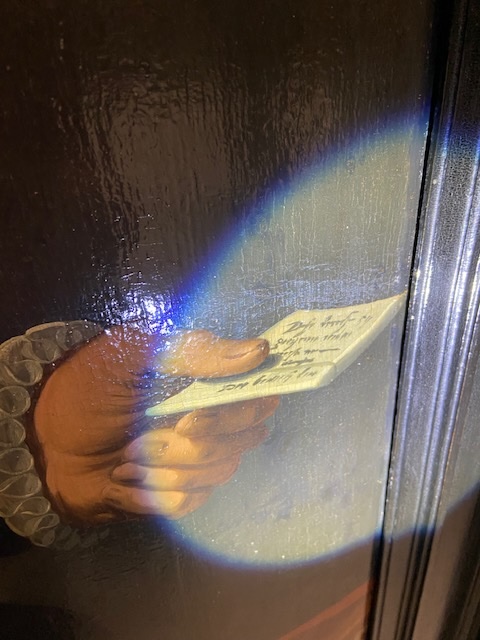
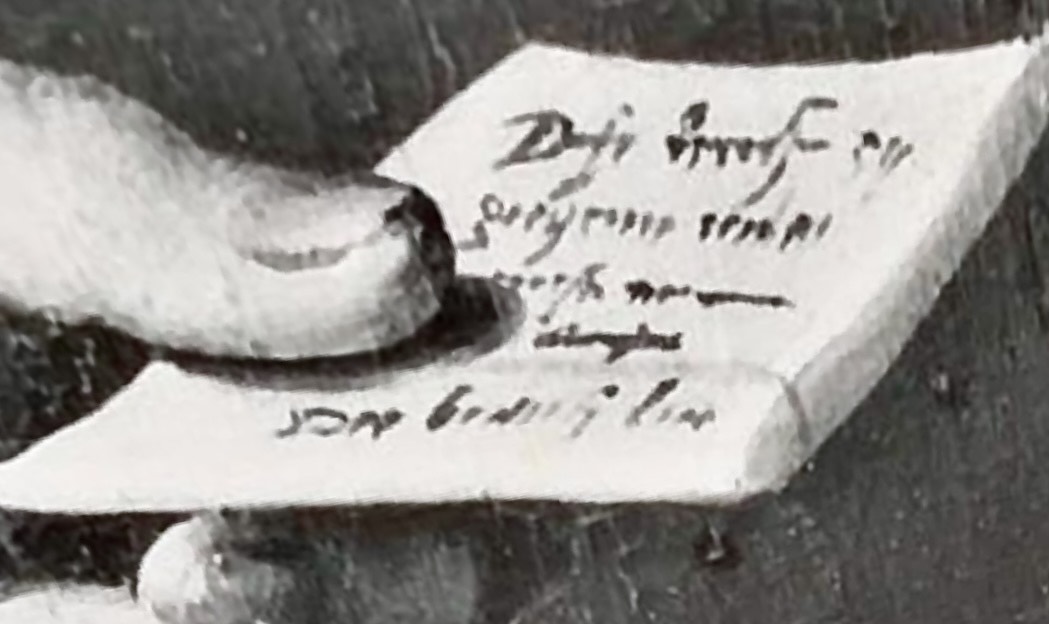
This is an unusual request on the Forum, and I realise it's a difficult task but would welcome even a small suggestion as to what the text says- if indeed it is readable at all.
The note is held in the hand of Adriaen de Vriese who lived in Harlaam. The portrait is dated 1580 when he was 32 yrs old. He was the great grandfather of the Schoonhoven sisters who I'm researching.
with many thanks as always.
Anne
p.s I'll add a second photo of the note- taken without illumination in case that's 'easier' to read....
Second photo without a light...
Dear Anne,
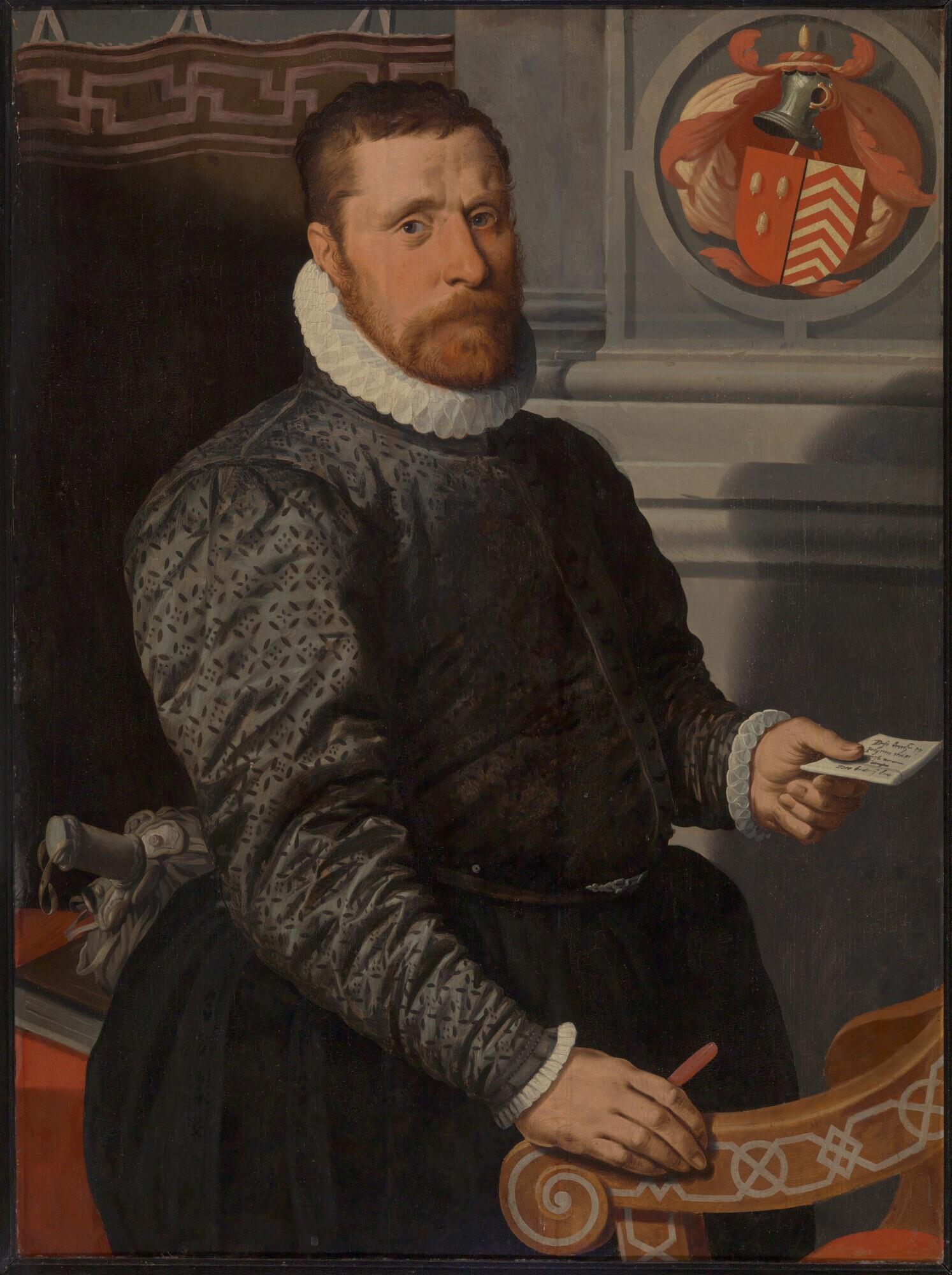
Here a digital version of the whole painting. The first line seems to open with 'Dese', the second with 'zeegenn'.
I can read: Dese brieff sy / ge..h..men <?> .... / gelijk tot ... , the rest might become clear too.
Well done Rene and Otto for having a go at transcribing this incredibly difficult text.
Thanks also for the copy of the portrait Rene. I was lucky enough to see the original in The Hague yesterday. I took the close ups of the note using my phone, but the note is on an angle in the portrait as you can see, so it was difficult to get a good shot.
So translating the 4 words which are legible I make it:
"This letter......equal to"
Otto where you put / was that the end of a line on the letter?
Is there any other way to enhance the text do you think that would help decipher it?
with my grateful thanks as always.
Anne
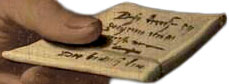
Photoshop-generated. It seems to say:
Dese brief sij
zoegenn eener
....
....
Attempt2
The painting of Adreain Dircksz. de Vriese stems from the collection of the Klaeuwshofje in Delft. It is since 1979 on loan in the holidngs of Museum Prinsenhof in Delft, https://www.museumprinsenhofdelft.nl/collectie/104880 , object no. B 49-3.. The painting is by Pieter Pietersz. The RKD record for it has only a black-and-white photograph, and the information needs updating, see https://rkd.nl/images/26359 . .
Anne, if it reads indeed gelijk this word means here probably "just as". I am trying to deform this image, too, but I have no yet advanced much. It reminds me of the Letterlokcing project, https://letterlocking.org/ , for opening and reading unopened Early Modern letters....
Additionally, it is also recorded in RKD images Lite: https://rkd.nl/imageslite/112892
Unfortunately, the literature listed there provides no clues about the inscription on the letter.
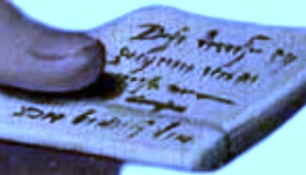
Attached is a detail from the RKD image, modified for better readability.
Dear Rene, Otto and Alexander
Many thanks once again for all your efforts and persevering with this problem.
It really is difficult to decipher- I guess that's why no one has done it before!
Adriaen's father Dirk de Vriese was a former Burgomaster of Haarlem, his wife Cornelia Francesdr Wij was also from a wealthy family in Haarlem. Both were from Catholic families. Perhaps the message in the letter has some reference to his family?
very best wishes
Anne
Dear Anne,
I haven’t found any clear Catholic clues in the portrait itself (for a good overview of what to look for, see the section “De ‘look’ van de katholieke kerk” in Lenarduzzi’s chapter in Katholiek in de Republiek, 2019, pp. 166–171). As a result, it remains unclear whether the letter makes any reference to family ties or faith.
That said, I just learned that Iris Jocker, with support from the Vereniging Rembrandt, has recently been continuing her research at Museum Prinsenhof Delft, focusing especially on the Klaeuwshofje and the paintings and household objects that belonged to this women’s almshouse. It could be well worth getting in touch with her.
Dear Alexander
Many thanks for all your suggestions.
I've been recommended Lenarduzzi's book by the Prinsenhof museum, who also put me in touch with Iris!
We corresponded about a few points I wanted to ask her about the Schoonhoven sisters, who are the main focus of my research, (which is about 17th century women pottery owners in Delft) but of course this whole family are interesting.
Iris is busy writing a book for the 17th century society on the Klauewshoef, due to be published next year I understand. I shall look forward to reading her book in due course.
I'm really grateful for your contributions. If you know of any further experts who could read the rest of the note that would be great as I know the Prinsenhof are just as curious to know what it says as I am :-)
With very best wishes
Anne
Dear Anne,
At the risk of disappointing you; it seems to me that first of all, the letter is closed, so what we see is the 'backside' with the adress, and secondly and accordingly, it reads something like "Desen brief sy / gegeven ...", the rest remaining illegible.
Dear Michel
Many thanks for your contribution to this puzzling item.
From what I've read about epistolary imagery in Early Modern paintings -found on a great website 'SKILLNET' from Utrecht University a letter is generally recognised by the folds in the paper. So I thought this was just a note- until some of the wonderful contributors on this site were able to decipher the first line, as you have- Desen brief sy = "This letter says"...a few more words have been decoded..zoegen eener ..."to seek one" ....gelijk tot "just as"....
So many questions remain, for example was the viewer of the portrait meant to be able to 'read' the letter (perhaps in better condition in 1580?) or would they have understood by Adriaen's position in society that this was associated with his business? Or was it simply to show he was a literate man of letters, a well educated individual.
Finally I'd love to know why he has a slightly puzzled/worried look to him. I guess we'll never know!
very best wishes
Anne
Dear Anne,
Assuming that we may read "Desen brief sy / gegeven ...", it would mean in English: "This letter is to be delivered ...". The rest of the (supposed) adress really is unreadable to me, therefore I cannot agree with Otto and René on "gelijk tot" nor on "zoegen eener". However, the second word on the last line might be "brengher" (English: bearer).
For a note, the paper looks too thick, so it almost has to be a folded letter. Furthermore, it looks as if there's a string around the letter, which is a bit odd, because letters were usually closed with a wax seal. This brings me to the question what the red thing might be in Adriaen's right hand. Could it be the handle of some sort of stamp die?
In my opinion, the answer to your question wether the viewers were meant to 'read' the inscription is negative: I think that the inscription was primarily meant to identify the paper in his hand at a single glance as a letter.
Dear Michel
Thank you for your very interesting reply about the mystery letter.
I agree with you it does look too thick to be just a note. But unlike you I hadn't noticed the string around the letter.
I did wonder what the red thing in his hand might be- I wondered if it was a pen, but of course in those days pens were made with quill, so that doesn't fit either.
There is one theory I have about the letter. Adrieaen's father was Dirck de Vriese who was mayor of Haarlem in 1572.. It seems that in a letter that Mayor Dirk de Vries wrote, one of the envoys to Don Frederik, but who had remained in Amsterdam for safety's sake, wrote to the citizens of Haarlem, imploring them to surrender to the Spaniard; they would receive mercy and thus avoid the fate of Naarden.
Could this be a family heirloom Adriaen is holding? Everyone who saw the portrait would have know he was the son on Dirck de Vriese and the role his father's letter played in the surrender of Haarlem.
But as I say- it's just a theory :-)
best wishes
Anne
p.s. Adriaen's wife family -the de Wj's were also involved in the siege of Haarlem....
Anne,
Just stumbled upon this interesting thread. The text on this folded letter is indeed very difficult to read due to the angle from which we are looking at it. I don't think I can add much to the laudable attempts above; they are on the right track and I agree on the text for the first line; the rest is more problematic. But I did want to add a few other thoughts:
1) Paintings in the 16th/17th century, including some portraits, often contained symbolism and/or "coded" messages. By that I mean the use of objects and details in the image that added meaning or context to those spectators that recognized the symbols. It's possible that the artist did not mean for the letter to be fully readable. He may have picked a specific piece of text that had meaning to those who were "in the know". It is also strange to even see any text at all. The way letters were typically folded would have hidden the content entirely from view. The only text on the outside would relate to the addressee, e.g. some honorary title, a name, a town, and maybe a street or house name. This may all be part of artistic liberty; adding specific details to help tell the story/context to those that were somewhat "in the know".
Maybe there was a specific letter that Adriaen Dircksz de Vriese sent that was of importance in his life or maybe even of importance to the community he was part of. Is there a specific event he was involved with not too long before the painting was created? If so, seeing Adriaen with this letter in his hand, and maybe aided by the little bit of text that is shown, may have been enough from those "in the know" to recognize what letter he was sending without being able to read it.
Also, from my perspective, the letter looks rather "new". Not like an heirloom that is already years old and touched by many hands.
2) The letter being new connects with what I think the red object is in his right hand: a stick of wax used to place a seal. Such sticks were pretty much like a candle and also had a wick in them. They were usually not round in shape, but rather triangular or square, like a (thin) stick of butter. This could also be related to what seems to be like a string as others pointed out. I'm not entirely sure it is a string (the black line is very subtle) but if it is, then the wax seal may have been placed on top of it.
Summarizing, I would suggest the portrait shows Adriaen preparing to send a letter. He had written and folded the letter and was ready to put a wax seal on it. The letter must have been important enough to justify this being how Adriaen was portrayed. Considering the portrait was allegedly painted in 1580 and Adriaen was only 32 years old, this probably means the event happened in or not long before 1580 (but not say 10 years earlier when he was technically still a minor).
Take this for what its worth; just some possible interpretations of what we're looking at.
Best,
Marcel
Dear Marcel
Thank you for your thoughts about the letter in the hand of Adriaen de Vriese. All contributions are welcome :-)
I agree there has to have been a reason for Adriaen and his wife Cornelia to have their portraits painted in 1580. As far as I understand they were not marriage portraits as they don't 'face' one another.
A lot was happening in Haarlem during this period, as I'm discovering through my research. In 1577 the Spanish left, but in 1578 there was the 'Haarlemse noon' which would have affected Adriaen & Cornelia as they were both from wealthy, influential Catholic Haarlem families. For example Cornelia's father was the Regent of St Elisabeth's hospital until 1573.
I think Adriaen and Cornelia married around 1577 -perhaps after the Spanish had left? They had a daughter, also called Cornelia in late 1577-1578 as there's also a portrait of her, aged 5 yrs in 1583. She's also mentioned in the joint will of Adriaen and Cornelia in 1578.
But that still doesn't bring me to any significant event in 1580 connected with a letter. I need to try and find out what Adriaen's father Dirck de Vriese was doing in 1580 as he, along with Cornelia's father had both been involved in the war with the Spanish in 1572/73.
very best wishes
Anne
Anne
zei op woensdag 26 november 2025 - 13:00